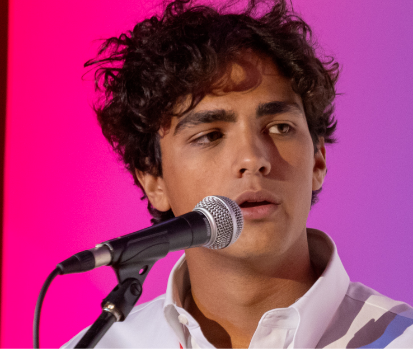
Oliver Ciric is a Serbian-American filmmaker based in Boston, MA. He’s a recent film production graduate of Emerson College, where he worked on a variety of award-winning films. His feature length documentary The Bird (Or: Marty, Clown) (2021) premiered in-competition at the 14th Beldocs IFF, where he was the youngest filmmaker to have a film in competition. His recent short film, “The Noblemen,” is currently in the film festival circuit.
Taking the bus with Damin, we left Zmajevo for the center of Bor, where he trains his boxing. Surrounded by his coaches, teammates, and friends, he leaned in to say “Oliver, here I am no longer Damin (a traditional Romani name), call me Nenad (a traditional Serbian name).” At this point, I was loosely exploring the prospect of making a documentary in Bor, but this sentiment of Nenad’s touched me as I realized that it was poignant in my own life. As a Serbian-American, I had two separate answers to the question “where are you from?” If I were asked this in the U.S., I would say I was Serbian; elsewhere I would say I’m American, but it wasn’t until Damin asked me to call him Nenad that I realized how inherent the compartmentalization of my own identities were.
Like many other filmmakers before me, I set my sights on the historically significant copper mining town of Bor, Serbia. Bor was one of the first outposts of French investments in the Balkans; a priority for the Nazis during the invasion of Yugoslavia; a poignant setting for pioneering Yugoslavian artists such as Dušan Makavejev. Today, it is assessed to be one of the largest copper deposits in the world as multiple countries still vie for influence within the town. I saw Bor as a city that continues to hold its status as the weathervane for Serbia, as the town rapidly became an outpost for Chinese Neo-colonialism.
Most importantly, Bor is the ultimate test of national identity in contrast to one’s place. Deep in the heart of Serbia, Bor lies as a town that is dominated by the Chinese, the Romani, and the Vlachs, perhaps making it one of the most diverse cities in the Balkans. Being here, I wondered: what makes someone Serbian? I have felt less Serbian in my life because I didn’t live in Serbia, but is living in Serbia enough to make one feel Serbian?
With open arms, I was invited into the Romani community of Zmajevo, a village that doesn’t even appear on maps nor government censuses. I heard tales of conflicting identities, a helpless political situation, and an uncertain future. In these children, I saw myself, conflicted with my own identity and unsure of how Serbian I am. Beyond this, I saw people who are Serbian-speaking citizens of Serbia, yet are discriminated against within their own country. I saw myself within this community of people who are conflicted about their identity within their environment.
Filming in the village one day, Damin emerged from his home, walked into my frame, proudly proclaiming “I am a boxer! Watch me fight!” Seeing the bold charisma and perseverance of this young man, I knew I had a story that must be told.