When Dave Waller heads out on a whim to see a lighthouse up for public auction, he gamely climbs the 35 foot ladder to its “front door” and the five flights of crumbling stairs to the watch deck. The view of the Boston skyline is breathtaking and he is hooked. Equally smitten is self-made entrepreneur Bobby Sager, who drives the bidding war up to an historic high. Waller and his wife, Lynn, borrow more money and when Sager’s assistant fails to submit a bid, they become the proud owners of the most expensive lighthouse in history.
The Wallers embark on renovations, ferrying volunteers with a stomach for this kind of adventure out to Graves on Miss Cuddy, a retired Coast Guard boat. There is no dock so Miss Cuddy is moored; people, supplies, and equipment have to be rowed by Waller in a perpetually deflating dinghy and hoisted up from the water using a pulley system. It is a slow, painstaking process greatly impacted by tides and weather. Waller quickly runs out of funds, but serendipitously Sager reemerges on the scene and they decide to share the costs and ownership of Graves. Renovations now continue in earnest. Waller discovers an Australian lighthouse engineer, and throws him into the Herculean task of rebuilding and installing an original Fresnel lens. However, all of the press surrounding the project entices the town of Hull to claim the property and hit Waller with a tax bill ballooned with additional fines of $25k for every day of ownership. Waller and Sager decide to wage legal war and fight a corrupt City Hall to save Graves.
Filmmaker Statement
Having worked with Dave Waller for several years, I knew him to be quite the collector. His home, which is a firehouse he literally renovated from ashes, houses all his treasures including neon signs and a full sized diner. When I heard he bought a lighthouse—well, it seemed like a very Dave-like thing to do. As the story behind Graves unfolded, I was fascinated by Dave’s scrappiness and determination as well as his ability to rally the help of hundreds of people from all walks of life. His story really is a celebration of the creativity, ingenuity and endurance that can take a crumbling obelisk and make it not only habitable but a work of art.
Like Dave, I didn’t consider myself a lighthouse enthusiast at first. Getting out there in rough seas, climbing the 35 foot laddered entrance, hauling gear as well as groceries in a small dinghy through choppy surf is not for the faint of heart, but the stunning view from the top balcony melts all of that arduous effort away. My cinematographer, Adam Mikaelian, and I stowed our equipment aboard the Miss Cuddy III and sailed out to Graves with Dave at the helm no matter what size the swells. To do this story justice required using all the cinematographic recording tools available: drone cameras, iphones, stop action film, archival footage, tracking down and interviewing all of the key players and many trips across the Boston Harbor. I have never been tested more and I’ve never been prouder to have chronicled this story of human resilience, craftsmanship, and community.
Project Stage
We are in the final stages of our edit and are looking for funds to help license necessary archival and stock footage as well as finish music, color and graphics.
The Team
Kim DiVincenzo – Director / Producer
Labor of Love: The Restoration of Graves Light marks Kim Divincenzo’s debut as a feature documentary director. With her professional background as a video and commercial director for two decades, she is adept at crafting narratives that resonate with audiences on an emotional level. This project gave her the opportunity to step far from her comfort zone, and is a testament to her resilience and unwavering commitment to her craft. To help tell this story in an authentic way she was given access to the Wallers, Bobby Sager, lighthouse engineer, Tim Nguyen, president of the U.S. Lighthouse Society, Jeremy D’Entremont, Boston Globe reporter, Emily Sweeney, the town of Hull’s former Town Counsel, James Lampke and several friends and volunteers who participated in the restoration. After hearing the harrowing stories, meeting the folks that volunteered their time and tireless energy, and seeing the incredible craftsmanship of the work that was done, it became clear that she needed to bring this wild and inspiring story to light in a way that celebrates the creativity, ingenuity and the good old fashion New England grit that made it happen.
Adam Mikaelian – Director of Photography
Adam Mikaelian is an accomplished Director of Photography (DP) proudly based in Boston, Massachusetts. As a DP, Adam is passionate about capturing the beauty in the world and preserving it on film. His favorite projects are those about people and communities that strive to make a positive impact on our world and its inhabitants. He is dedicated to creating stunning visuals that engage an audience and best illustrate a story. His readiness to “send it” has taken him on an extraordinary journey of visual storytelling throughout the world. He is always up for an adventure to get the perfect shot be it skiing camera in hand or bootpacking up a mountain or straddling a boat flying across the Boston Harbor. No matter the location, for him it really is the people that make the experience.
David Dinisco- Editor
With decades of experience in almost every aspect of video production, David specializes in Creative Direction, Live Action Directing and Creative Editorial. His focus is primarily on short-form storytelling, but one of his most gratifying projects was an 80 minute documentary, a passion project about his parents, All Together. Labor of Love is his second feature length documentary.
Destroy All Girls is a feature film drama and road movie set against the backdrop of inline street skating in New Jersey and New York City.
Alex Martínez is stuck. Living at home with an overbearing Catholic mother while caring for her older brother Gabriel, a former competitive rollerblader who was injured in an accident, Alex numbs herself with substances and by cruising the streets of Union City, New Jersey on skates. When a group of international skaters pass through her local skate park making a video, Alex jumps on the opportunity to join them. Bouncing around NYC with nothing other than her skates and a camcorder, Alex begins to fall for the group’s enigmatic leader, Cameron, and the line between finding and losing herself starts to blur.
Creative Team
Starring Ani Mesa, Gil Perez Abraham & Dominic Bruce
Directed by Erin Vassilopoulos
Written by Ani Mesa & Gil Perez-Abraham
Screenplay by Flo Baumann & Erin Vassilopoulos
Produced by Ben Cohen, Joy Jorgensen & Chris Dagostino
Associate Producer – Ray Mendez
Process
The movie is an exciting hybrid: scripted and stylized, the cast combines trained actors with street cast skaters and was shot on a blend of 16mm film and mini DV video.
Status
Working with film editor Olivia Neergaard-Holm (The Chronology of Water, The Apprentice), we recently locked the edit. At this stage we’re making a push to raise the remainder of the financing we need to finish the film, which includes sound design, score, and our color grade. We have some exciting collaborators lined up for this next phase including sound designer Eli Cohn (Barbara Forever, Familiar Touch, Peter Hujar’s Day).
Thank you for considering supporting our project!
What was the world like in the two weeks immediately preceding 9/11? In this documentary, which was shot over the 14 days before the attacks, that life is in full view.
“14 Days” is the story of The Islands Cup, and is a real-time, intimate portrait of an international windsurfing competition held in Quebec’s Magdalen Islands during the final two weeks leading up to the September 11 attacks. Shot in “direct cinema” style, the film unfolds linearly from the evening of August 27 to the morning of September 11, 2001, documenting the rhythms of competition and a place and time in the world of an extreme sport. Watching those never to be repeated moments viewers are immersed in a world defined by movement and freedom, a community gathered for something pure and immediate, sails snapping in the wind, boards screaming across the water, world-class competitors pushing themselves to the edge. The days are punctuated by athlete interviews and all of the races that two weeks take up. “14 Days” allows the tension to build subtly through Sound Design and the passage of time, until the competitors gradually depart the Islands, just before news of the attacks begins to unfold. Juxtaposing the intimate, contained world of the athletes with a sudden, irreversible shift happening beyond their horizon.
Ultimately, the film serves as both a time capsule and a meditation on innocence before upheaval, capturing what it feels like to exist fully in a moment just before history fractures it. By interweaving the focused world of windsurfing with the broader context of a world about to change, “14 Days” reflects on memory, and the fragile boundary between ordinary life and global transformation.
Baby Bird follows Helen, an American-born Chinese nanny working for a Chinese family, who has recently suffered the loss of her mother. Her life revolves around her young ward, Xiao Shao, a lonely boy and the only bright spot in her life, whose habit of running away from school she enables behind his mother’s back.
One day, Helen finds a collection of old Chinese workbooks in her late mother’s things, showing how Helen had drawn away from learning Mandarin as a child. Helen realizes that the only memento of her that her mother had chosen to keep was the evidence of her failing to be fluent in her mother tongue, leading her to become consumed by the idea that her mother had secretly resented her.
Hurt and confused, Helen begins to lose sight of the person her mother truly was and, in her memories, starts to see her as a colder, crueller—and, eventually, more violent—version of herself. At the same time, her position within the household and in the eyes of Xiao Shao’s mother grows tenuous, putting her relationship with Xiao Shao at risk.
Baby Bird’s central ethos is to explore second-generation immigrant experiences through horror and to break from the expectation that stories about Asian diaspora identity cannot also be genre pieces. It is a film that balks against rationalization and puts us face-to-face with the moments where we spiral and lose control of how we see the people around us. When understood, language creates community and connection; when it’s not, it’s a form of brutal, painful alienation. And what better way to show brutality than through blood and gore?
This documentary is a profoundly moving and relatable exploration of the life journey of Major General Dr. Lakhvinder Singh Vohra (retired), a globally renowned oncologist. Throughout his career, he saved countless lives, yet he was unable to save those dearest to him. His world shatters when his wife is diagnosed with cancer, leading to a personal breakdown. However, he ultimately finds the strength to rebuild his life and embarks on a new path as a singer.
Dr. Vohra’s life story vividly illustrates the unwavering resilience of the human spirit, showcasing its capacity to heal and flourish, even in the most formidable trials. It serves as an inspiration for anyone facing their own challenges, reaffirming the idea that by remaining true to their beliefs, they can discover a path to happiness and fulfillment. “Harmony of Healing” delves deeply into the spirit of “chardi kala.”
Your support can make a world of difference.
- Join our community: Become a vital member of our mission to inspire and uplift. Your presence and engagement help us reach more hearts.
- Spread the Message: Share Dr. Vohra’s inspirational story within your networks and social circles. By amplifying our message, you contribute to spreading positivity and resilience.
- Embrace Your Passion: Just as Dr. Vohra discovered his love for music, explore your passions and support others in finding theirs. Your journey may inspire countless others.
- Donate: Your financial support is essential for bringing this heartwarming story to life. Every contribution, big or small, paves the way for the film’s success.
- Connect with Your Sikh Values: For the Sikh community, this is an opportunity to embrace your beliefs of seva and chardi kala. Join hands with us in sharing these values with the world.
Let’s make “Harmony of Healing” a shared endeavor. Together, we can uplift spirits, encourage resilience, and inspire change. Join us on this journey today, and let’s create a brighter, more harmonious world, one full of healing and happiness.
STORY
Major Event: The film opens with a major event, a music contest specially organized for doctors from around the world. Among the talented participants is Dr. Vohra, who reveals that he is one of the finalists selected from a pool of 7,000 doctors.
Dr. Vohra’s Backstory: Through a series of flashbacks, we delve into Dr. Vohra’s backstory, understanding how he became an Army doctor and chose to specialize in oncology after his mother’s tragic battle with cancer. Despite his efforts, he couldn’t save his father-in-law and his brother from the same illness, further driving his dedication to his profession.
Years of Dedication: The narrative explores the subsequent years where Dr. Vohra devotes himself wholeheartedly to his mission of saving lives, working tirelessly in the medical field. Following his retirement from the army, he joins a Guru Nanak Dev Hospital at Tarn Taran Sahib that provides free cancer treatment to patients and later becomes a professor of surgery, imparting his knowledge to aspiring doctors.
Personal tragedy: Dr. Vohra’s wife falls ill during her visit to their son. A routine checkup reveals an advanced stage of cancer, leaving no hope for treatment. This devastating diagnosis shakes Dr. Vohra to his core, leading him to return to Jalandhar to care for his ailing wife.
A New Chapter: After his wife’s passing, Dr. Vohra honors his commitment to the college but vows to never practice surgery again, avoiding the operating theater and intensive care units. Seeking solace and a fresh start, he discovers his talent and passion for music.
Onstage Transformation: The film culminates in a pivotal moment where Dr. Vohra takes the stage in front of a large audience, participating in the music contest. Though he may not win the competition, his heartfelt performance resonates deeply with the audience, winning their hearts.
Spreading Happiness: Dr. Vohra embraces a new purpose in life, dedicating himself to singing and traveling. While occasionally offering advice to friends and family over the phone, he focuses on spreading the message of happiness through his music, finding fulfillment in touching the lives of others.
Timeline
Research: Completed
First phase of shooting: Completed
Second phase of shooting: Completed
Third phase of shooting: Completed
Round 1 Editing: Completed
Post Production: Oct – March 2025
Release: May 2025
The Curious Incident of Everett Wilder is the story of a lonely boy who encounters a jackalope at his birthday party in 1952. Following this curious incident, Everett becomes obsessed with catching the uncatchable horned rabbit. With the help of the enigmatic Lucy Hayworth, the secret of the jackalope will be revealed.
We’ve already shot the film, but need your support and teamwork to finish the project by financing post production [specifically the creation of the jackalope]. Animation is a complex and time consuming process, and in order for the visual effects to be the best that they can be, we will need your help. Animation for the jackalope will cost $20,000. The primary goal of this effort is to fund the jackalope animation. We have an animatable jackalope model and a company selected to bring these shots to life. We also have a sound mix that is complete (apart from the jackalope sounds), and a colorist who is ready to go once the film is complete.
Budget Breakdown:
Animation: $20,000
Color: $1,500
 STATUS
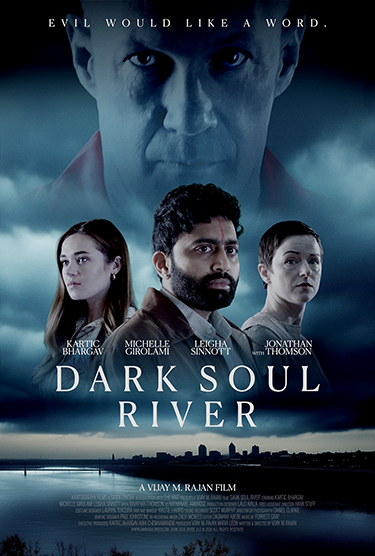
We’re almost done! — but we need your help. The psychological thriller film DARK SOUL RIVER is projected to be done in May 2026. We just need our last little bit of money to cross that finish line.
If you would like to be a part of the story behind this film, please click the blue “DONATE TO THIS FILM” button above to contribute what you can!
REWARDS
Any person who donates more than $25 will receive a copy of the digital poster when the film is ready to be released.
Any person who donates more than $50 will receive a digital copy of the film when it’s done, plus the above.
Any person who donates more than $100 will receive their name in the credits under “Filmmakers Collaborative Sponsors” plus all of the above.
SYNOPSIS
For over a decade, the Kaw Valley Killer terrorized the cities around the Kansas River. Now, he’s been identified as a landscaper named Nathanael Ambrose. And five days before his execution, Ambrose claims he’s finally willing to reveal where the rest of his victims are buried —
— but there’s a catch. He’ll talk only to the brother of his final victim.
Now Saarathi, a devout Hindu–who arrived from India only to settle the affairs of his sister–will be immersed in this cat-and-mouse conversation with a serial killer.
HELP US ACHIEVE OUR DREAMS
In this movie, that can best be described as The Silence of the Lambs with a cross-cultural element, thrills and shocking twists combine with philosophical/theological explorations of the human soul.
This film, completely independently funded and shot in the burgeoning film community of central Illinois, is also the brainchild of a team of talented, creative up-and-coming artists — all more than capable of bringing a Hollywood-level edge and sensibility to a lower-budget independent film. The goal is to achieve distribution and share this twist-filled story with as many viewers as possible through theatrical and/or streaming distribution.
But we need your help. Only with your support can this project take flight.
Thank you to everyone who makes our dreams possible.
STAY UPDATED
Visit the official website at darksoulriver.com or follow us on Instagram!
This film shines a light on the trailblazing role of women war artists, on front lines round the world, championing the female perspective on conflict through art, asking: when it’s life or death, what do women see that men don’t?
Women war artists break the taboo, punching through to create their unique record alongside the daily newsfeed. But in countries where journalism is banned, it’s art that shows us the truth. Where violence against women and rape are used as weapons of war, women are silenced and bear the brunt of displacement, civilians and families pay the price. Multi-award-winning film director Margy Kinmonth shows how war is a catalyst to bring out artists’ most creative work. In the face of destruction they inspire, provoke, imagine, memorialise and heal, seek to disarm – tell the truth to power. Traditionally a male domain, war art by women has been largely invisible. Until now…
Today wars continue to rage globally. In this film, Kinmonth champions contemporary female artists – witnesses and survivors of international conflict, who create art and tell their unique stories. Womens’ war art is also uncovered from attics and archives, revealing an artistic legacy previously hidden from view. An entirely female cast and contributors makes this film a unique undertaking – telling vital truths in traumatic times.
Filmed in the USA, United Kingdom, Ukraine, Sudan, Austria, Belgium and Italy, contributing artists include Shirin Neshat, Dame Rachel Whiteread, Maya Lin, Nina Berman, Marcelle Hanselaar, Cornelia Parker and Lee Miller.
CURA is a work of ritual cinema that redefines climate storytelling through an immersive, sensory experience co-created with Indigenous guardians of the Amazon. This isn’t a film you watch—it’s a ceremony you enter. Audiences recline in a shared, floating hammock beneath a suspended screen, wrapped in a 12-channel rainforest soundscape. Spatial audio and felt vibration pulse through the body—until the forest’s heartbeat feels like your own.
Born from deep collaboration with the Nomanawa Clan of the Noke Koi (Brazil) and the Cofán of Putumayo (Colombia), CURA bypasses language and data to speak to the nervous system—awakening embodied memory and ecological kinship. Through vibration, imagery, sound, and ceremony, it reconnects body and forest as one living system.
At a time when climate discourse can paralyze with despair, CURA offers something vital: a felt experience rooted in Indigenous wisdom—a re-membering that shows healing ourselves and healing Earth are not separate journeys, but one sacred path.
Thank you for making a tax-deductible donation to support this work.
For more information, please visit our website
The New Tibet is a Chilean documentary about the movement of the Earth’s energy center from the Himalayas to the Chilean desert.
When reviewing the sacred knowledge of ancient civilizations, we find that, in almost all of them, there is talk of marked periods that divide time into eras of approximately 13,000 thousand years. Each of these eras concludes with the alignment of the equinoxes: which, as we know today, are nothing more than the movements of the axis of our planet.
The beginning of a new era began precisely in 2012, in which it is thought that Kundalini energy, which was previously found in Tibet, has moved from the Himalayas to the Andes Mountains, settling mainly in the Chilean desert.
This is a cultural project, which offers a scientific view based on seismic movements in the Pacific Ring of Fire; but it also presents images and testimonies of communities surrounding the Chilean desert; who recognize that they have experienced a process of energy transformation.
Our project takes a route of the history of Tibet as a spiritual center of humanity and the hypothesis of the displacement of its energy to the Chilean desert.
“The New Tibet” is a documentary that invites us to reflect on our beliefs, the concept we have of spirituality and how it impacts our worldview and consciousness.
For more information, please visit www.thenewtibet.com